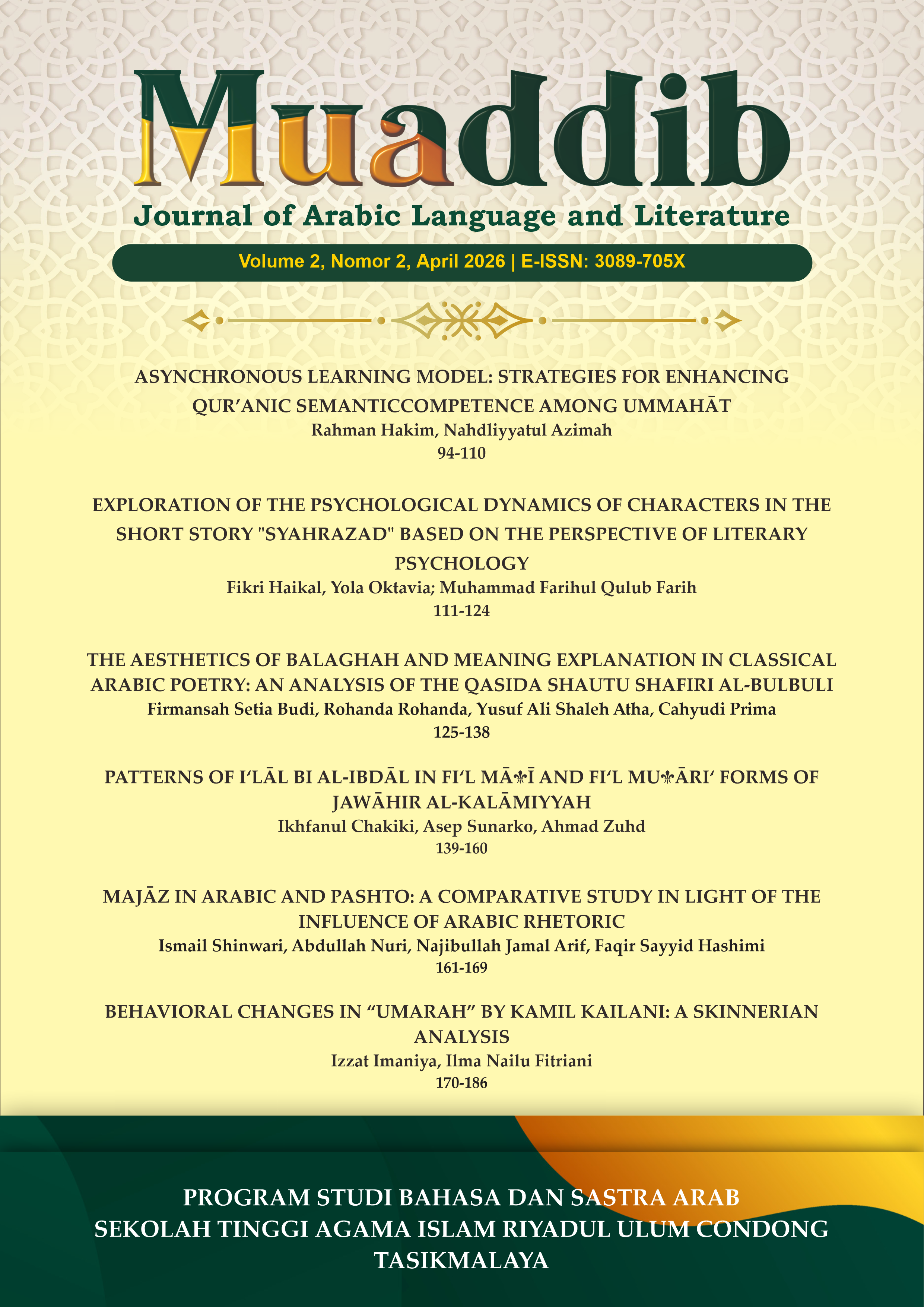
EXPLORATION OF THE PSYCHOLOGICAL DYNAMICS OF CHARACTERS IN THE SHORT STORY "SYAHRAZAD" BASED ON THE PERSPECTIVE OF LITERARY PSYCHOLOGY
EKSPLORASI DINAMIKA KEJIWAAN TOKOH DALAM CERPEN “SYAHRAZAD” BERDASARKAN PERSPEKTIF PSIKOLOGI SASTRA
DOI:
https://doi.org/10.51190/muaddib.v02i02.68Keywords:
shahrazad, Inner conflict, SyahrazadAbstract
This study aims to analyze the psychological dynamics of the characters in the short story Syahrazad through a literary psychology approach. This approach is used to examine the psychological construction of the characters reflected in the narrative, particularly those related to inner conflict, motivation, traumatic experiences, and the expression of the characters' personalities throughout the story. This study uses a qualitative descriptive method with text analysis techniques as the main data source. The analysis focuses on the central characters and the psychological dynamics that influence their development in the story. The results show that the characters in the short story Syahrazad represent the complexity of emotions and psychological conditions characterized by ambivalence between hope and fear, courage and vulnerability. In addition, the use of symbolism, storytelling techniques, and the development of the storyline also strengthen the representation of the psychological dimensions of the characters in depth. These findings emphasize that literary works function not only as aesthetic products, but also as reflective media capable of representing human psychological dynamics in a subtle and profound manner.
References
Anggita, D., & Satriani, I. (2025). Kajian Kritik Sastra dengan Pendekatan Psikologi Sastra pada Cerpen Kucing Setan yang Merasakan Cinta karya Cicilia Oday. DIDAKTIS: Jurnal Pendidikan Bahasa dan Sastra Indonesia. DOI: https://doi.org/10.33096/didaktis.v3i2.924
Atkinson, J. W. (1964). An Introduction to Motivation. Princeton: Van Nostrand.
Ayuwulandari, D., Nurhasanah, & Pratama, R. (2024). Analisis konflik batin tokoh utama dalam novel Rasa menggunakan pendekatan psikologi sastra. Jurnal Kopula, 10(2), 45–56.
Aqillah. (2025). Sastra sebagai Cermin Realitas dan Ekspresi Kreativitas Manusia. Jakarta: Pustaka Cendekia. DOI: https://doi.org/10.33096/didaktis.v3i2.924
Beauvoir, S. de. (1949). Le Deuxième Sexe [The Second Sex]. Paris: Gallimard. Endraswara, S. (2008). Metodologi Penelitian Psikologi Sastra: Teori, Langkah, dan Penerapannya. Yogyakarta: MedPress.
Dohona, M., Siregar, R., & Hutapea, T. (2023). Konflik batin tokoh dalam karya sastra: Kajian psikologi sastra. Jurnal Pendidikan Tambusai, 7(3), 11245–11252.
Farhah, E. (2018). Pencitraan Perempuan dalam Drama Syahrazād karya Taufiq Al-Hakim: Kajian Feminisme. Yogyakarta: Universitas Islam Negeri Sunan Kalijaga.
Festinger, L. (1957). A Theory of Cognitive Dissonance. Stanford: Stanford University Press.
Frankl, V. E. (1963). Man’s Search for Meaning: An Introduction to Logotherapy.
New York: Washington Square Press.
Freud, S. (1949). An Outline of Psychoanalysis. New York: W.W. Norton & Company.
Fitriyani, L., Wibowo, A., & Sari, D. (2025). Analisis konflik batin tokoh berdasarkan teori psikoanalisis Freud dalam novel Indonesia. Jurnal Sasindo, 13(1), 67–78.
Goleman, D. (1995). Emotional Intelligence: Why It Can Matter More Than IQ. New York: Bantam Books.
Jung, C. G. (1959). The Archetypes and the Collective Unconscious. Princeton: Princeton University Press.
Kailani, K. (n.d.). Syahrazad Bintu Al-Wazir. Kairo: Dar Al-Maarif.
Kohlberg, L. (1981). Essays on Moral Development, Vol. 1: The Philosophy of Moral Development. San Francisco: Harper & Row.
Lewin, K. (1935). A Dynamic Theory of Personality. New York: McGraw-Hill.
Maghfirah, S., & Latuconsina, H. (2025). Konflik batin tokoh utama dalam novel Negeri di Ujung Tanduk: Kajian psikologi sastra. Jurnal Bahasa dan Sastra, 9(1), 15–27
Maharani, N. K. D. B., Rai, I. B., & Wirani, I. A. S. (2024). Analisis Psikologi Sastra Tokoh Utama pada Cerpen Meong-Meong karya Made Sanggra. Jurnal Pendidikan Bahasa Bali Undiksha. https://doi.org/10.23887/jpbb.v12i2.100637
Maslow, A. H. (1943). A Theory of Human Motivation. Psychological Review, 50(4), 370–396. https://doi.org/10.1037/h0054346
Maslow, A. H. (1970). Motivation and Personality (2nd ed.). New York: Harper & Row.
Maulidiyah, D. F. (2024). Analisis Tokoh Utama dan Karakter dalam Drama Syahrazad dengan Pendekatan Psikologi Sastra. Malang: Universitas Negeri Malang.
Minderop, A. (2013). Psikologi Sastra: Karya Sastra, Metode, Teori, dan Contoh Kasus. Jakarta: Yayasan Pustaka Obor Indonesia.
Sukini, S., Rahmawati, I., & Nugroho, B. (2024). Konflik intrapersonal tokoh dalam karya fiksi: Perspektif psikologi sastra. Jurnal Bahasa dan Sastra Indonesia, 8(2), 101–110.
Wellek, R., & Warren, A. (2014). Theory of literature. New York: Harcourt Brace & Company.
Downloads
Published
Issue
Section
License
Copyright (c) 2026 Muaddib: Journal of Arabic Language and Literature

This work is licensed under a Creative Commons Attribution-ShareAlike 4.0 International License.