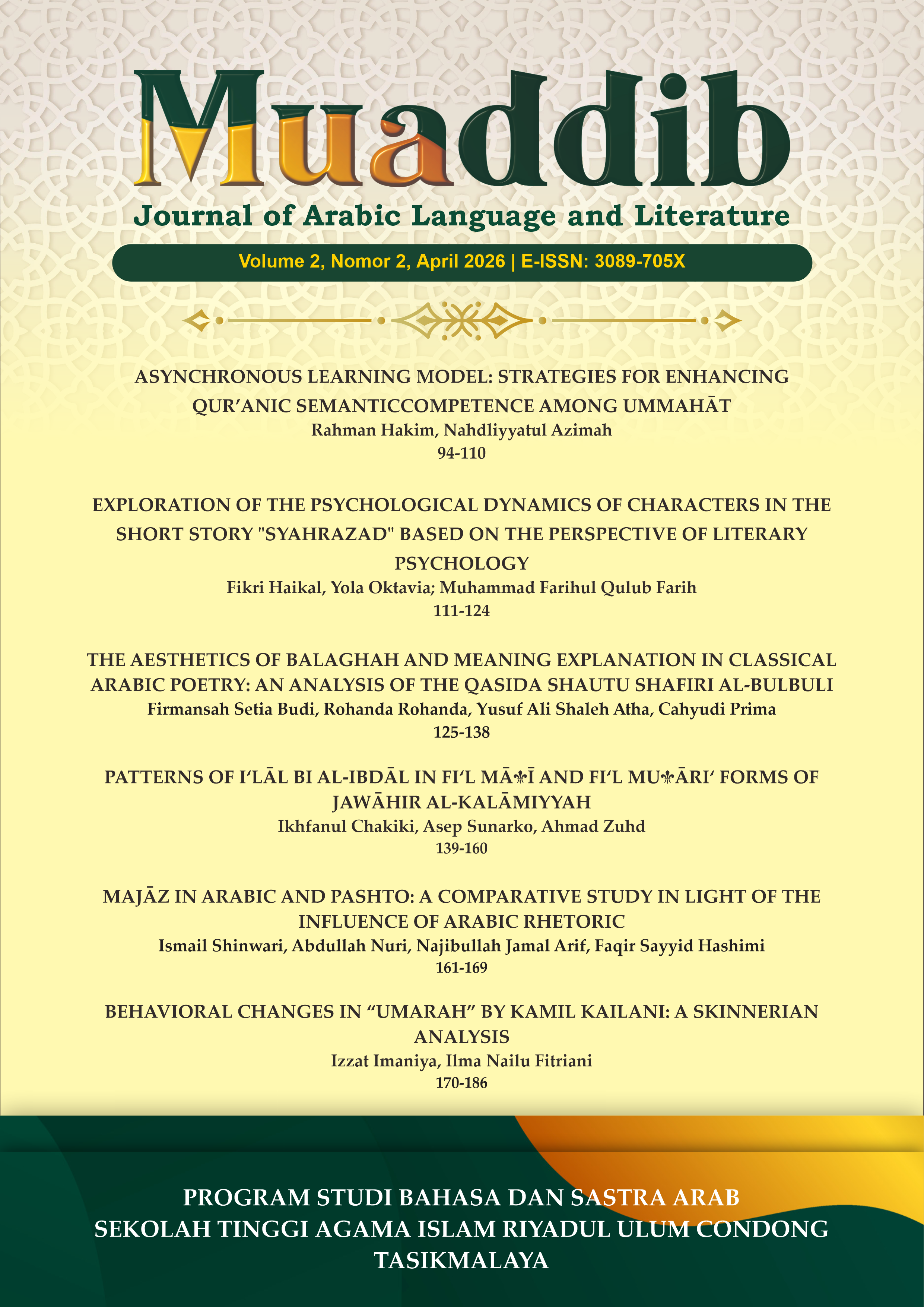
MAJĀZ IN ARABIC AND PASHTO: A COMPARATIVE STUDY IN LIGHT OF THE INFLUENCE OF ARABIC RHETORIC
AL-MAJĀZ BAYNA AL-‘ARABIYYAH WA AL-BASHTŪWIYYAH: DIRĀSAH MUQĀRANAH FĪ ḌAW’I AL-TA’ATHTHUR BI AL-BALĀGHAH AL-‘ARABIYYAH
DOI:
https://doi.org/10.51190/muaddib.v02i02.55Keywords:
Arabic rhetoric, figurative language, majaz, Pashto languageAbstract
This study explores majāz (figurative language) in Arabic and Pashto, focusing on its conceptualization, classification, and usage. As a central element in balāghah (rhetoric), majāz functions to convey meanings beyond literal interpretation. This research aims to examine the similarities and differences between the two languages while identifying the influence of Arabic rhetorical tradition on Pashto. Using a qualitative descriptive-comparative approach based on library research, the study analyzes data from classical Arabic rhetorical works and Pashto linguistic literature. The findings indicate that both languages share a similar definition of majāz as a word used beyond its original meaning with a contextual indicator (qarīnah) preventing literal interpretation. Moreover, both traditions classify majāz into comparable categories, particularly istiʿārah (metaphor) and majāz mursal (metonymy). However, minor differences are observed in stylistic usage and contextual application. The study further reveals that Pashto rhetoric is significantly influenced by Arabic balāghah, especially in conceptual frameworks and classification systems. Thus, the relationship between the two is not merely one of similarity, but also of intellectual influence and conceptual transfer.
References
Āzmūn, L. P. (1400). Adab tīorī. Kabul: Samūn Publishing.
Al-Hāshimī, A. (2016). Jawāhir al-balāghah fī al-ma‘ānī wa al-bayān wa al-badī‘. Beirut: Dār al-Kutub al-‘Ilmiyyah.
Al-Jārim, ‘A., & Amīn, M. (2015). Al-balāghah al-wāḍiḥah. Karachi: Jam‘iyyah al-Bushrā al-Khayriyyah.
Al-Jurjānī, ‘A. Q. (2001). Asrār al-balāghah (A. al-Ḥ. Hindāwī, Ed.). Beirut: Dār al-Kutub al-‘Ilmiyyah.
Al-Jurjānī, ‘A. Q. (2001). Dalā’il al-i‘jāz (M. M. Shākir, Ed.). Cairo: Maktabat al-Khanjī.
Al-Qazwīnī, J. al-D. M. (1932). Al-talkhīṣ fī ‘ulūm al-balāghah (‘A. al-R. al-Barqūqī, Ed.). Cairo: Dār al-Fikr al-‘Arabī.
Al-Qazwīnī, J. al-D. M. (1993). Al-īḍāḥ fī ‘ulūm al-balāghah (M. ‘A. al-Mun‘im Khafājī, Ed.). Beirut: Dār al-Jīl.
Al-Sakkākī, Y. ibn A. B. (1987). Miftāḥ al-‘ulūm (N. Zarzūr, Ed.). Beirut: Dār al-Kutub al-‘Ilmiyyah.
Al-Zu‘bī, K. (2015). Dirāsāt fī al-linguistics al-muqāran. Amman: Dār al-Fikr.
Bārakzī, M. Ḥ. (1958). Dīwān Mīrzā Ḥanān Bārakzī. Quetta: Ṣaḥāf Publishing.
Hamkār, M. I. (1392). Pa Pashto manẓūm hindī sabk ke da majāz dawālūnah. Nangarhar: Khatīz Publishing.
Muslim Dūst, ‘A. R. (1393). Khwāghah zhabah Pashto ma‘ānī, bayān, badī‘ aw da shi‘r dawālūnah. Nangarhar: Momand Publishing.
Muslim Dost, A. R. (2014). Al-balāghah fī al-adab al-bashtuwī. Kabul: Dār al-Nashr al-Waṭanī.
Najār, F. W. (1401). ‘Ilm al-bayān. Nangarhar: Momand Publishing.
Shaykh Amīn, B. (1982). Al-balāghah al-‘arabiyyah fī thawbihā al-jadīd: ‘Ilm al-bayān. Beirut: Dār al-‘Ilm li al-Malāyīn.
Downloads
Published
Issue
Section
License
Copyright (c) 2026 Muaddib: Journal of Arabic Language and Literature

This work is licensed under a Creative Commons Attribution-ShareAlike 4.0 International License.