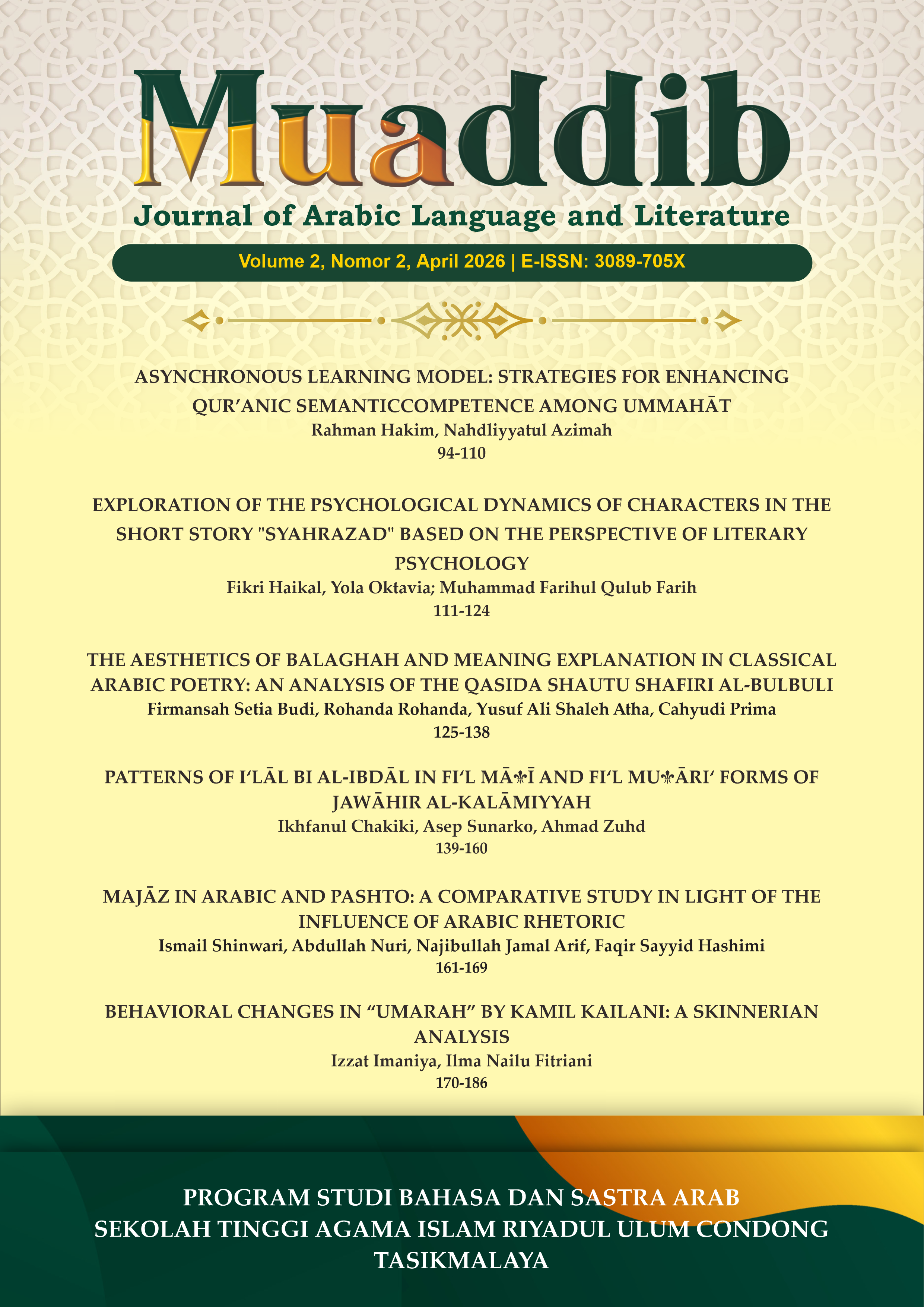
PATTERNS OF I‘LĀL BI AL-IBDĀL IN FI‘L MĀḌĪ AND FI‘L MUḌĀRI‘ FORMS OF JAWĀHIR AL-KALĀMIYYAH
POLA I‘LĀL BI AL-IBDĀL PADA FI‘L MĀḌĪ DAN FI‘L MUḌĀRI‘ DALAM KITAB JAWĀHIR AL-KALĀMIYYAH
DOI:
https://doi.org/10.51190/muaddib.v02i02.69Keywords:
Arabic morphology, fi‘l māḍī, fi‘l muḍāri‘, i‘lāl bil ibdālAbstract
Arabic morphology or ṣarf, has a regular system of word formation, one of which occurs through the process of i‘lāl bi al-ibdāl, namely the substitution of letters in certain morphological environments. This study aims to identify the forms of i‘lāl bi al-ibdāl in fi‘l māḍī and fi‘l muḍāri‘ in Kitab Jawāhir al-Kalāmiyyah and to explain the rules governing their changes. This study employs a qualitative approach with library research as its research type. The data were collected through documentation and analyzed using content analysis and morphological analysis. The results show that there are 115 occurrences of i‘lāl bi al-ibdāl, consisting of 82 occurrences in fi‘l māḍī and 33 occurrences in fi‘l muḍāri‘. In fi‘l māḍī, the findings include 58 cases of thulāthī mujarrad, 16 cases of thulāthī mazīd biharfin,and 8 cases of thulāthī mazīd biharfaini. In fi‘l muḍāri‘, the findings include 20 cases of thulāthī mujarrad, 9 cases of thulāthī mazīd biharfin, and 4 cases of thulāthī mazīd biharfaini. The forms of change found include the substitution of yā’ into alif, wāw into alif, hamzah into alif, wāw into tā’, and tā’ into dālaccompanied by idghām. These findings indicate that i‘lāl bi al-ibdāl in Kitab Jawāhir al-Kalāmiyyah occurs systematically and in accordance with the rules of ṣarf.
References
Amrulloh, M. A. (2017). Fonologi Bahasa Arab (Tinjauan Deskriptif Fonem Bahasa Arab). Jurnal Al Bayan: Jurnal Jurusan Pendidikan Bahasa Arab, 8(1). https://doi.org/10.24042/albayan.v8i1.353
Asadi, I. A., Vaknin‑Nusbaum, V., & Taha, H. (2023). The Role of Morphological Decomposition in Reading Complex Words in Arabic in Elementary School Years. Journal of Psycholinguistic Research, 52(6), 2863–2876. https://doi.org/10.1007/s10936-023-10024-x
Aspers, P., & Corte, U. (2021). What is Qualitative in Research. Qualitative Sociology, 44(4), 599–608. https://doi.org/10.1007/s11133-021-09497-w
Aulia, M. S. (2025). Idgham, I’lal, Dan Ibdal Dalam Bahasa Arab (Studi Kontrastif Dengan Kaidah Meluruh Dalam Bahasa Indonesia). Argopuro: Jurnal Multidisiplin Ilmu Bahasa, 8(4). https://doi.org/10.8734/Argopuro.v1i2.365
Bengtsson, M. (2016). How to Plan and Perform a Qualitative Study Using Content Analysis. NursingPlus Open, 2, 8–14. https://doi.org/10.1016/j.npls.2016.01.001
E. Watson, J. C. (2021). Arabic Morphology: Inflectional and Derivational. Dalam K. Ryding & D. Wilmsen (Ed.), The Cambridge Handbook of Arabic Linguistics (1 ed., hlm. 405–424). Cambridge University Press. https://doi.org/10.1017/9781108277327.018
Farwaneh, S. (2020). Non-sound’ verb Inflection in Arabic: Allomorphic Variation and Paradigmatic Uniformity. Morphology, 30(1), 61–89. https://doi.org/10.1007/s11525-020-09350-w
Foote, R., Qasem, M., & Trentman, E. (2020). Morphological Decomposition in L2 Arabic: A Masked Priming Study. Journal of Psycholinguistic Research, 49(2), 291–317. https://doi.org/10.1007/s10936-020-09688-6
Hachoumi, H. (2023). The Morphophonology of Moroccan Arabic Personal Pronoun Affixes. Revue Langues et Littératures, 93-133 Pages. https://doi.org/10.34874/PRSM.R2L-V28.44188
Haddad, B., Awwad, A., Hattab, M., & Hattab, A. (2018). Associative Root–Pattern Data and Distribution in Arabic Morphology. Data, 3(2), 10. https://doi.org/10.3390/data3020010
Hakim, M. L. (2020). Proses Morfologis Wazan-Wazan Fi'il Mazid Dan Maknanya Dalam Al-Quran Juz 28. Tarling: Journal of Language Education, 3(2), 201–228. https://doi.org/10.24090/tarling.v3i2.3532
Hanifah, M., Siti Fatimah, T., & Azhari, F. (2025). I’lal and Ibdal in The Poetry Of Ahmed Shawqi (An Analytical Morphological Study). Muaddib: Journal of Arabic Language and Literature, 02(01), 24–37. https://doi.org/https://doi.org/10.51190/muaddib/v02i01.48
Issa, I. (2023). Morphological Complexity in Arabic Spelling and Its Implication for Cognitive Processing. Journal of Psycholinguistic Research, 52(1), 331–357. https://doi.org/10.1007/s10936-022-09896-2
Kassmi, R., Mourchid, M., Mouloudi, A., & Mbarki, S. (2020). Recognition of Arabic Phonological Changes by Local Grammars in NooJ. Dalam H. Fehri, S. Mesfar, & M. Silberztein (Ed.), Formalizing Natural Languages with NooJ 2019 and Its Natural Language Processing Applications (Vol. 1153, hlm. 3–14). Springer International Publishing. https://doi.org/10.1007/978-3-030-38833-1_1
Morgan, H. (2022). Conducting a Qualitative Document Analysis. The Qualitative Report. https://doi.org/10.46743/2160-3715/2022.5044
Muhamad, R. H. (2020). Al-I‘lāl: Ḥaqīqatuhu wa Ahammiyyatuhu fī aṣ-Ṣarf al-‘Arabī. International Journal on Humanities and Social Mu, 17. https://doi.org/10.33193/IJoHSS.17.2020.155
Risqiani, T. M. (2025). Analisis Perbandingan Proses Fonologis: Ibdal Dan I’lal Dalam Bahasa Arab Dan Peluluhan Dalam Bahasa Indonesia. AT-TAKLIM: Jurnal Pendidikan Multidisiplin, 2(6), 439–453. https://doi.org/https://doi.org/10.71282/at-taklim.v2i6.463
Setiyadi, A. C. (2024). The Jussive Mood in Arabic Grammar. Dalam A. C. Setiyadi, Jussive Particles and Nouns in Classical Arabic (CA) and Modern Standard Arabic (MSA) Conditional Sentences (Vol. 10, hlm. 19–77). Frank & Timme GmbH. https://doi.org/10.57088/978-3-7329-8815-0_2
Shahbari-Kassem, A., Schiff, R., & Saiegh-Haddad, E. (2025). Development of Morphological Awareness in Arabic: The Role of Morphological System and Morphological Distance. Reading and Writing, 38(8), 2235–2267. https://doi.org/10.1007/s11145-024-10581-0
Sholihah, ‘Amilatu, & Hasan, Moh. A. K. (2020). Analisis Ibdal Dalam Al-Qur’an Perspektif Abu Hayyan Al-Andalusia An-Naysaburi Dan An-Nasafi (Studi Komparasi Atas Penafsiran Q.S. At-Taubah: 33, Q.S. Al-Fath: 28, Dan Q.S. As-Saf: 9). Profetika: Jurnal Studi Islam, 21(2), 197–211. https://doi.org/10.23917/profetika.v21i2.13080
Snyder, H. (2019). Literature Review as a Research Methodology: An Overview and Guidelines. Journal of Business Research, 104, 333–339. https://doi.org/10.1016/j.jbusres.2019.07.039
Vaknin-Nusbaum, V., & Saiegh-Haddad, E. (2020). The Contribution of Morphological Awareness to Reading Comprehension in Arabic-speaking Second Graders. Reading and Writing, 33(10), 2413–2436. https://doi.org/10.1007/s11145-020-10048-y
Wa-Mbaleka, S. (2020). The Researcher as an Instrument. Dalam A. P. Costa, L. P. Reis, & A. Moreira (Ed.), Computer Supported Qualitative Research (Vol. 1068, hlm. 33–41). Springer International Publishing. https://doi.org/10.1007/978-3-030-31787-4_3
Downloads
Published
Issue
Section
License
Copyright (c) 2026 Muaddib: Journal of Arabic Language and Literature

This work is licensed under a Creative Commons Attribution-ShareAlike 4.0 International License.